The Smithsonian American Art Museum dates a sheet of tattoo flash attributed to “Professor” Zeiss to about 1940–1945. The museum lists the sheet as ink on paper mounted on paperboard. It gives the work an object number, 1986.65.226, which is a more useful search term than the title alone. Several works in the collection share the title Tattoo Flash.
Start with what the museum records
Flash is a set of prepared tattoo designs. A museum catalog describes the particular sheet that survived. The Zeiss record gives its dimensions as 10 by 15 inches. The description of the paper and its backing tells us about the object in the collection. It leaves open who mounted it, where it was used, and whether anyone chose a design from that sheet. Those questions would take other records, such as a dated studio photograph or a documented account from someone who handled it.
The museum does not currently show an image on the Zeiss record. Its subject tags can help you find related works, but they are a poor basis for reconstructing where a motif sits on the page or what the original drawing looks like. Keep the record link with your notes so you can check what the museum actually makes available.
Read the date as carefully as the name
“Ca.” means “circa,” or “approximately.” The Zeiss date gives a short range with uncertainty built in. A different flash sheet credited to Leonard L. St. Clair, object 1998.84.34, has only a twentieth-century date. Making that date as precise as the Zeiss entry would add information the museum does not supply.
The two records also describe different materials. The Zeiss record names ink, paper, and paperboard. The St. Clair entry lists pen and ink, colored inks, and pencil on paper. Take down those words before reducing both records to “ink drawings.” Specific materials make it possible to compare more sheets later and see patterns in how a collection was documented. See our guide to tattoo ink and material history for another example of using material descriptions as evidence.
Keep a note another reader can follow
For each sheet, record the museum, artist attribution, approximate date, materials, and object number. Save a direct link and write any interpretation on its own line. If you find a photograph elsewhere, check whether the object number matches before pairing it with a caption. A matching title alone can easily lead you to the wrong sheet.
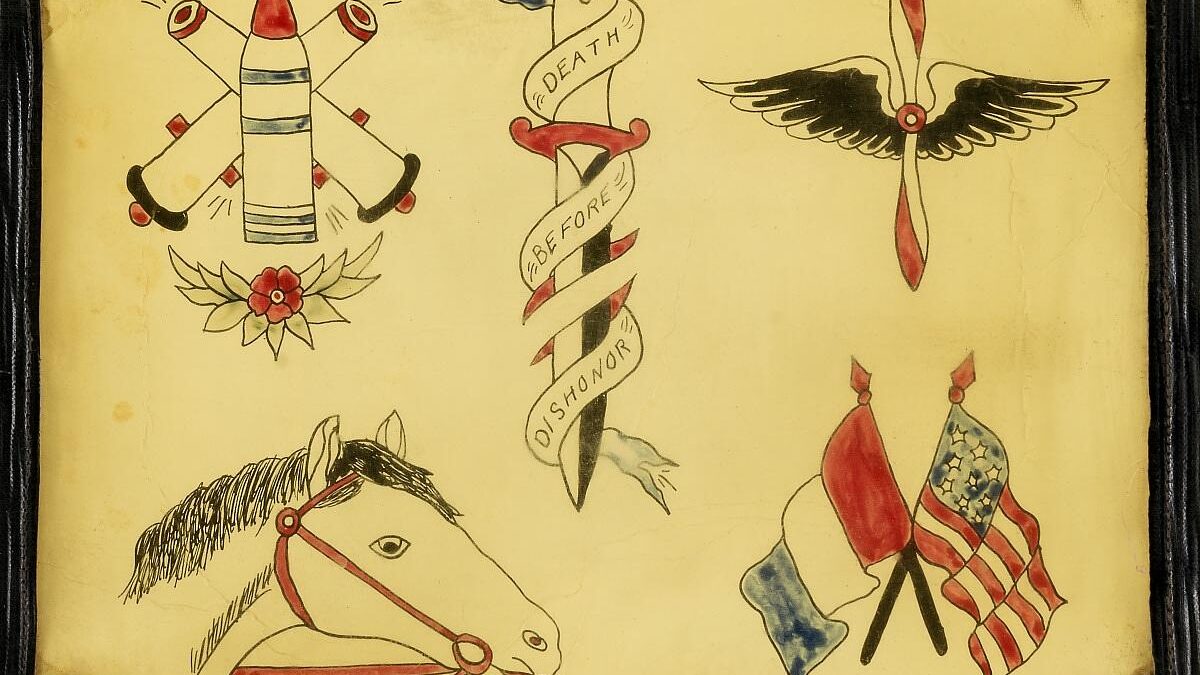
Featured image: a separate twentieth-century Tattoo Flash sheet by an unidentified artist, object 1998.84.50F. Smithsonian American Art Museum, gift of Herbert Waide Hemphill, Jr. The museum marks the image free to use. See the Smithsonian Open Access terms and our editorial standards.